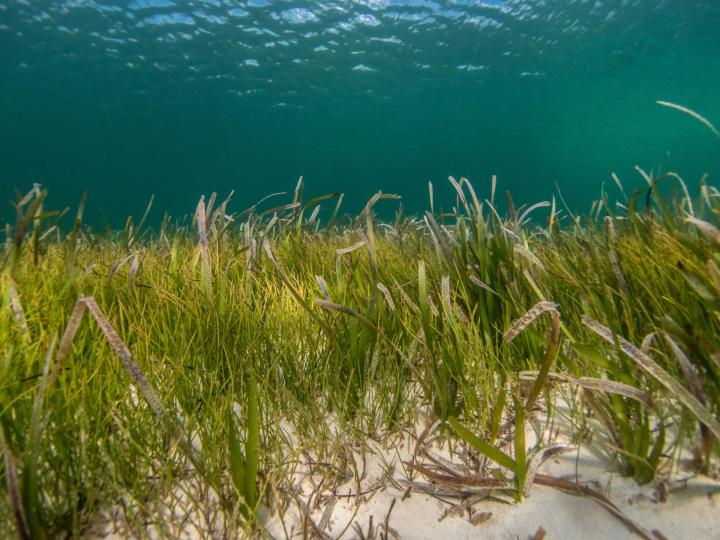
New research by Queen’s University Belfast has found that seagrass meadows across Northern Ireland, including those that have legal protection from human disturbance, are under threat from severe pollution linked to agricultural run-off and sewage.
Seagrass meadows are among the most valuable habitats in our coastal waters. They store carbon, nurture young fish, and shellfish, stabilise sediment and buffer shorelines from storms.
They are also woven into the heritage of coastal communities who have fished and foraged around them for generations, but they are disappearing worldwide and nitrogen pollution is one of the main drivers of this decline.
This research, published in Marine Pollution Bulletin, is a region-wide assessment of seagrass condition in Northern Ireland using biochemical indicators.
From the sheltered waters of Strangford Lough to the exposed coast at Waterfoot Bay, seagrass leaves were collected from nine meadows and tested for nitrogen pollution. Every meadow sampled sits inside a marine protected area, a stretch of sea that has given legal protection to safeguard the wildlife living there, and every site was found to be polluted beyond the limit for healthy seagrass.
The study identified two nitrogen thresholds that could serve as early-warning indicators for managers. When nitrogen content in seagrass leaves rises above 1.8%, plant growth begins to suffer. Above 2.8%, the decline accelerates rapidly, and in this danger zone small increases in pollution trigger disproportionately large plant losses.
Heidi McIlvenny, a PhD student from the School of Biological Sciences at Queen’s, led the research. She said:
“Seagrass takes up nutrients straight from the water around it, so the chemistry of the leaves gives us a longer-term record of pollution than a one-off water sample could. To work out where the nitrogen thresholds leading to plant loss are, we drew on tissue data from studies across 13 countries. We then tested meadows in Northern Ireland against these thresholds, and not one came back below the limit.”
Heidi added: “Dundrum Bay, on the County Down coast was the starkest example. On paper it’s classified as healthy. In reality, nitrogen levels there were nearly double what seagrass can tolerate, and surveys over the past decade show dense mats of green algae smothering what is left of the meadow.
“But Castle Espie, just up the coast in Strangford Lough, tells a completely different story. The seagrass there is thriving, and the difference is the wetland reserve next to it. The reedbeds and willows act as natural filters before any of that water reaches the Lough. It shows recovery is possible, but only if we deal with what is coming off the land.”
Dr Sarah Helyar, Senior Lecturer from the School of Biological Sciences at Queen’s, said the work provides essential tools to facilitate monitoring:
“This study makes clear that lines on a map don’t protect ecosystems. The same species, with the same legally protected status, can thrive or collapse depending on what is happening in the catchment. Monitoring still focuses on how much seagrass is left, but once a meadow starts shrinking, the damage has already been done.
“Tissue chemistry can detect stress much earlier, and the nitrogen thresholds identified in this study offer a practical early warning system for environmental agencies. Meadows at or above 1.8% nitrogen warrant closer monitoring and intervention to reduce nutrient inputs, while those exceeding 2.8% require urgent action to reduce nutrient inputs from catchments - before they pass the point of recovery.”
This research suggests that seagrass meadows can recover, but only if pollution is tackled at its source. Researchers at Queen’s suggest better management of agricultural runoff, investment in sewage treatment, and recognising that marine conservation cannot stop at the high tide mark.

Read the Spring 2026 edition free online →
Stay connected with NI's tech community: