How AI is exploring turning patient stories into an early warning system for Northern Ireland's health system
Every day, patients across Northern Ireland share their experiences of healthcare. Some stories are positive. Others raise concerns. Most, until recently, they remained individual stories.
Indicaretor is changing that. Built through a collaboration between Queen's University Belfast, the Regulation and Quality Improvement Authority (RQIA), Care Opinion, and the Public Health Agency — and brought to life through Momentum One Zero's innovation infrastructure — it uses natural language processing to analyse patient feedback at a scale no human team could manage. Indicaretor delivers a dashboard that shows the potential of tracking how care quality changes across services, teams and organisations delivering care over time, surfacing signals of good practice for spread and scale, and risks to remediate.
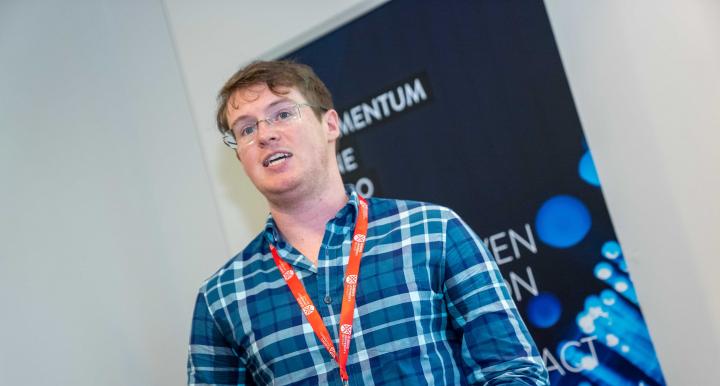
We sat down with Dr. Chris Hawthorne, the researcher behind the build, to find out how it works, what it has shown, and where it goes next.
RQIA — the healthcare regulator for Northern Ireland — was interested in exploring AI as an early warning system for patient narratives. What funnelled their interest in this space?
RQIA receives large amounts of textual and information concerning the registered organisations they regulate but less information about services provided outside of registered services, in statutory care. Patients and service users routinely provide feedback about their experiences through a public platform called Care Opinion, and when you consider this covers the whole of Northern Ireland, it quickly becomes a big data opportunity. Deriving key insights from that data has the potential to deliver real, positive change to the health and social care system.
When RQIA approached Queen's, the aim was to explore whether AI could catch those early signals from patient experiences — issues that have arisen before they snowball into something much bigger — while then also having the opportunity to spread, share and encourage good practice across the region.
Care Opinion has been gathering patient stories from Northern Ireland's health trusts for five years. What were those stories actually showing that nobody had been able to act on yet?
A single story on Care Opinion has the ability to improve health and social care. What makes it such an extraordinary platform is its ability to facilitate a direct response between healthcare staff and the patient about their experience — whether that experience is good or bad. Care Opinion already works with researchers across UK universities to analyse those stories.
What we were interested in was the bigger picture. When stories are pulled together, what do they collectively show, and how does that change over time? I always think of the Ulster Folk Museum — watching weaving on the loom, where every thread is vital to the overall fabric. Each individual story matters. But together they tell something much larger.
Applying NLP to unstructured health data sounds straightforward, but patient stories can be exceedingly complicated in narrative. What did you have to figure out before you could build something a regulator would trust?
I drew on my experience as a researcher and applied those same principles to the build. When information is presented, it needs to be easy to understand, transparent in where it has come from, and reproducible. Holding to those standards consistently shaped every conversation we had around the functionality and analysis within Indicaretor — and ultimately gave the regulator confidence in what we were showing them. They are keen too that this would not just be a tool available to the regulator but would be available to those providing services so that they can take steps to improve issues that are drawn out through Indicaretor.
During the build you were in regular discussion with RQIA and Care Opinion to test whether what you were building was actually useful to them. What did that collaboration look like in practice?
The nature of our discussions has always been rooted in a shared set of values: improving health and social care, listening to the patient voice, and empowering health and social care staff. Having those values clearly in place from the start shaped everything. They weren't just a backdrop — they were the reason the collaboration held together through the complexity of the build and why Indicaretor is what it is today.
The dashboard tracks positivity scores across cleanliness, food, level of care and staff communication at service, in services or at organisational delivery level over time. What does it look like in practice in identifying good quality care and areas of improvement?
Within Indicaretor, patient narratives are categorised into different topics, things that people are talking about in their stories of their experience, and the dashboard gives end users a trending view across all of them. Depending on the pattern of the signal, such as when a particular category is consistently receiving high positivity scores – highlighting a strong quality of care or equally when the positivity score is lower, it signals that this is an area for improvement. It is the patterns that emerge across many stories over time.
RQIA commissioned a second phase in March 2026, before the spin-out had even happened. What had Indicaretor shown them in phase one that gave them that confidence?
It was a testament to the ongoing relationship between Queen's, Momentum One Zero, Care Opinion and RQIA that we were able to continue the development of Indicaretor and move more deeply into its application in patient safety and organisational culture. That kind of sustained trust between partners doesn't happen by accident — it is built through consistent, transparent and high-quality collaboration delivering actionable insight.
Indicaretor Analytics Limited was spun out of Queen's in May 2026. What drove the decision to commercialise, and what does that make possible?
During the project it became clear that commercialisation could be the driver for longer-lasting impact, sustainability and broader delivery of what we set out to do — improving healthcare at scale. That realisation was supported by the strength of our relationships with RQIA and Care Opinion, and it paved the way for the spin-out. The commercial route is not a departure from the mission. It is how the mission reaches further.
Momentum One Zero brought together academia, public bodies and a social enterprise platform under one project. That is not a group of organisations that would naturally work with each other. What did having that convener make possible?
Momentum One Zero bridges an innovation gap. It brings together interdisciplinary academic research and pairs it with real-world problems across multiple sectors — enabling innovation for social good while also building commercially sound products in a supportive environment. In numerous meetings across this project, someone would say: 'To excuse the pun, but we've got some real momentum.' And I think that sums up what Momentum One Zero actually does.
Read the Summer 2026 edition free online →
Stay connected with NI's tech community: