A 3,000-year-old major prehistoric centre in Northern Ireland may be one of Europe’s first large, organised settlement, new research reveals.
Haughey’s Fort, located adjacent to Navan Fort (Emain Macha) outside Armagh in Northern Ireland, is a landscape best known as the Iron Age capital of ancient Ulster. It is also the backdrop for fabled tales of kings and heroes in the Ulster Cycle.
The site has early medieval literary connections linking it with kingship and religion, but new research now shows that the area was a thriving and complex hub much earlier, during the Late Bronze Age (1200–700 BC).
READ MORE: Queen’s joins UK project to tackle absenteeism and poor wellbeing at work
A new study, published in Antiquity, reveals that the site was a vast and carefully planned landscape from around 1200 BC, with signs of settlement, craft production and ritual. A newly discovered monument is the largest hillfort known from Northern Ireland, and one of the three largest known from Ireland or Britain.
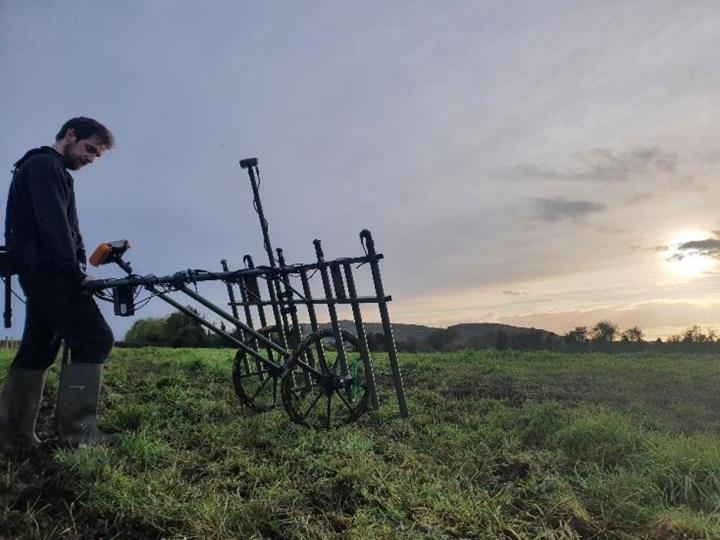
Led by Dr James O’Driscoll from University of Glasgow and Dr Patrick Gleeson from Queen’s University Belfast, the researchers used advanced remote sensing, geophysical survey, targeted excavation and archival reassessment and analysis to piece together the history of the site.
The study’s key findings include:
The research highlights that the site was a thriving and well-connected Bronze Age community, with signs of both economic activity and social organisation.
Imported objects also indicate long-distance connections to regions as far away as the Iberian Peninsula and Central Europe.
Dr James O’Driscoll, Lecturer in Geospatial Archaeology, at Glasgow’s School of Humanities, says: “Our research demonstrates a level of scale, organisation and connectivity in Bronze Age Ireland that has not been fully recognised until now. The evidence from Haughey’s Fort points to a large, densely occupied settlement where craft production, exchange and communal activity were all closely integrated.
“In a wider Western European context, this places Haughey’s Fort among the clearest examples of a proto-urban centre, showing that large, organised settlements were beginning to take shape around 3,000 years ago. This fundamentally changes how we understand the site and highlights the extent to which communities in Ireland were connected to broader developments across Bronze Age Europe.”
Dr Patrick Gleeson, Senior Lecturer in Early Medieval Archaeology, at Queen’s School of the Natural and Built Environment, explains: “This research offers a very unique and important insight into what life was like 3,000 years ago. Haughey’s Fort represents one of the most extensive and coherent Late Bronze Age landscapes in Western Europe, and shows how communities actively organised movement, belief and authority across a monumental setting.
“The study makes it clear that we are not looking at isolated monuments, but at a single, highly organised landscape.
“Our work shows that Haughey’s Fort, the King’s Stables, and the Creeveroe Earthworks were all part of an interconnected system, carefully structured to bring together settlement, production and ritual.”

Read the Summer 2026 edition free online →
Stay connected with NI's tech community: