
Tadhg Hickey, Head of AI & Digital Ethics Policy at AICC
Organisations across Northern Ireland are already using AI, but not everyone knows where or why. The good news is that there is a simple fix: being open about it. This is also the first thing regulators, legal frameworks and international standards are asking for.
Today, somewhere in Northern Ireland and everywhere else too, a customer is chatting with a business online, unsure if they are talking to a person or a computer. Somewhere else, staff members are using AI to draft emails or check figures, and their manager has no idea. Neither situation sounds dangerous by themselves, but both point to the same gap. Organisations are adopting AI faster than they are talking about it.
That gap is closing, whether organisations are ready or not. Since 02 August 2026, a new rule under the European Union’s AI Act has made one rule a legal duty for: if people are interacting with an AI system, they must be told. This rule is called Article 50 and is the most immediate practical part of a very large law. It does not ask businesses to prove that their use of AI is perfect. Instead, it asks for something much clearer: tell people when AI is involved.
For organisations who have never read a page of AI law or AI standards, that might sound like a small detail. It is the opposite. Transparency can be summarised as ‘being open about where and how AI is used’. It is turning out to be the easiest, cheapest, and most universally required step in the whole world of AI compliance. The remainder of this article explains why, and what to do about it.
One Rule: Almost everyone agrees on
AI regulation can feel like a maze of different rulebooks: The EU’s AI Act, international standards with names like ISO/IEC 42001, frameworks from the US National Institute of Standards and Technology (NIST), principles from OECD, and even local guidance from Northern Ireland’s AICC. Organisations could be forgiven for assuming they all say different things.
They do not. All of them treat transparency as a starting requirement, not an advanced feature. The OECD’s AI principles ask businesses to make people aware when they are interacting with AI, and to make it possible for people to understand and question what the AI has done. NIST’s framework says clearly that documenting and disclosing works “can enhance transparency, improve human review, and strengthen accountability. ISO/IEC42001 is the international standard for managing AI responsibly and integrates transparency as a core control. None of these frameworks agree on everything, but they do agree on transparency.
“Transparency is the one place where a European law, a US technical standard, and an international economic body all point in exactly the same direction, and it’s the easiest thing you can do.”
Evidence: What are organisations being asked for
Article 50 of the EU AI Act, live since August 2026, covers a specific but common set of situations.Let’s consider the following examples:
If a business uses a chatbot or virtual assistant that talks directly to a customer, it must make it clear that the customer is speaking to a machine.
If a business uses AI to generate content, like images, video, audio, or text, that content must be marked as AI-made in a way that can be detected.
It’s not overly complicated and neither example requires new technology. They both require evidence. They require a sentence, a label, or anAI-use notice.
As AI continues to develop, and more regulatory enforcement becomes common, high-risk tools, like using AI in hiring practices or credit decisions, will require more work: detailed instructions, human oversight or control records, and impact assessments. However, transparency is the part of compliance that is asked for now and costs the least.
Actions: Three easy habits, creating one accelerator
In practice, transparency comes down to three habits that any organisation, of any size, can start now. None of these require new software, a legal team, or a big budget. They only require a willingness to say plainly what is already happening inside the organisation.
The first habit is a transparency statement: a short, plain-language page, message, or document that says what AI is used for, what data it relies on, who is responsible, and how someone can raise a concern.
The second is ‘AI in use disclosure’: a line in a chatbot, an email footer, or a sign that simply says that AI is part of the process.
The third is open communication: making sure staff, customers, and suppliers can ask questions and get answers, rather than accidentally finding out AI is in use.
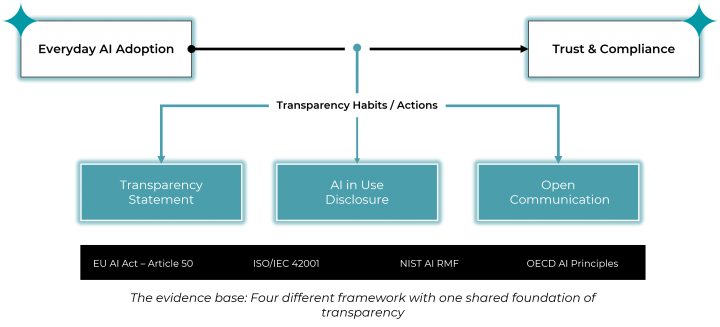
These three habits can be broken down into the following actions for AI transparency.
Say what the AI does and why it is used
Say what data feeds it, and where that data comes from
Say who is watching over it (a named role or team)
Give a way to contact a person about it
Dividends: Transparency is the foundation of trust
There is a commercial reason to move on this too, not just a legal one. Global research by Edelman (2025) found that only 44% of people feel comfortable with businesses using AI.Trust in AI, and comfort with it, rises sharply when people understand what is happening and why. Edelman’s own research describes hands-on familiarity and honest information as the fastest routes to building that trust. Northern Ireland already shows both sides of this equation: 88% of organisations report staff are using AI tools for work, but in the 2025 report The AI Pulse: Public Sentiment in Northern Ireland on Artificial Intelligence, found that just 12% trust AI to give accurate results, and only 7% trust it to be used ethically.
In other words, silence is what makes people nervous about AI, not the technology itself. A short, open statement does more to build confidence than any amount of technical reassurance a customer cannot see.
“People don’t distrust AI. They distrust not being told or informed about it. Transparency is the cheapest form of responsible AI a business can practice.”
Start being Transparent now
None of this requires legal training or a large budget. The AICC’s Responsible AI Hub offers free, plain language tools built to support you, including a Data Fact Sheet and AI Policy builder to help organisations produce effective evidence. Being transparent about AI does not mean a business has finished its responsible AI journey. It means you have taken the first step: the step that every regulator, every standard, and every customer is already asking for.
Transparency will not, on its own, satisfy every future obligation under the EU AI Act or standards, especially for higher-risk use cases. However, it is the one thing every framework in the space already agrees on, it is the step available today and it costs almost nothing. In AI compliance and regulation, that makes transparency the accelerator, not the brake.

Read the Autumn 2026 edition free online →
Stay connected with NI's tech community: