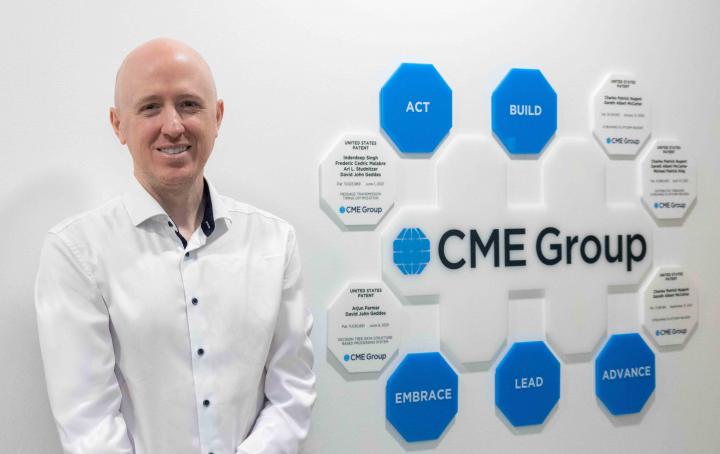
I’m a UK and European Patent Attorney working at CME Group in Belfast. My job sits at the intersection of law, technology and finance. My academic background is in physics, and I’ve always enjoyed trying to understand how things work. After starting my career in private practice, finding an in-house patent attorney role in Northern Ireland with a world-leading fintech company such as CME Group felt like hitting the jackpot. It’s a privilege to work closely with our software engineers at the forefront of financial technology, helping to protect the company's valuable inventions in the heart of Belfast’s growing tech community.
Protecting intellectual property is an essential business function across all industries. In terms of confidential information, patents, trade marks and copyright, how do software engineers typically engage with these rights?
When it comes to the creation of protectable IP rights, software engineers are often the “prime movers” who generate the core ideas on which IP rights are based. For example, software code is protected by copyright, and through writing code, engineers automatically create enforceable IP rights (e.g. the right to stop others from copying and using that code). Confidential information and trade marks are other examples of IP rights that software engineers will be very familiar with and encounter every day.

For patents and inventions, software engineers will often be the ones who generate the inventive ideas and also bring ideas to life in the real world. I love engaging with software engineers at CME Group, a place where patentable inventions flow quite naturally from the day-to-day problem-solving tasks that our engineers are engaged in. Also, for many of our inventors, having their name on a granted patent provides a great sense of achievement. CME Group engineers are generally curious about all aspects of IP, and how it can help to secure and support CME Group’s leading position in the derivatives industry.
Can you walk us through what actually makes a piece of software patentable and what's the single biggest misconception developers and businesses have about protecting their software with patents?
In a nutshell, software is patentable if it provides a new and non-obvious technical solution to a technical problem. It’s not about the code itself, but how the code works and what it actually does. For example, if a piece of software can be used to make a computer processor faster, smaller or more efficient, then that software is more likely to be considered technical/patentable. On the other hand, if a piece of software can only be used to make a business or administrative process faster or more efficient (without changing the way the underlying computer itself works or operates), then that software is less likely to be considered technical/patentable.
I spend a lot of time trying to determine whether or not an idea would be considered technical. The meaning of the word “technical” can be hard to pin down and has to be judged on a case-by-case/territory-by-territory basis. I think this uncertainty results in a common misconception that you can’t patent software at all - you definitely can. However, the laws of many countries mean that, in practice, not all software can be patented.
AI tools are increasingly being embedded in most developers' workflows. What are some of the interesting new challenges and IP-related questions that you see emerging in this space?
The rise of AI-assisted coding presents some fascinating challenges, for example around ownership and inventorship. Over the past few years, courts in several countries have found that only humans can be considered inventors and authors for the purpose of obtaining patents and copyrights, leaving a potential protection gap for innovations that are purely AI-generated. It's a rapidly evolving area, and at CME Group, we are constantly learning and adapting our strategy.
Are software patents treated differently in the US, UK, and EU and how do organisations navigate this while operating across global markets?
There are some crucial differences in how software patents are treated across the globe. At the European Patent Office, there’s a strong emphasis on the invention having a "technical character", and it’s often challenging to obtain European patents for software-implemented business methods. At the US Patent and Trademark Office, the focus is often around whether the invention is considered an "abstract idea” and the legal landscape has been shaped by a series of landmark court decisions. The UK Intellectual Property Office generally follows the European approach, but the UK has its own caselaw and nuances which at the time of writing are in something of a state of flux. Navigating the differences between jurisdictions requires a global patent strategy. I work closely with my US colleagues and our outside counsel to ensure that CME Group patent applications are prepared in a way that gives them the best chance of success in all key jurisdictions.
As new technologies continue to evolve, what areas of software development are expected to attract the most significant patent activity in the future?
Perhaps unsurprisingly, I think that the most significant and exciting area for future patent activity will be around AI. AI has the potential to transform every industry on the planet, so naturally there is a global race at the moment for patents which protect these innovations.
Of course, securing meaningful patent protection for AI-based inventions is complicated by the strict rules around patenting software, and I think this is exactly why the area will be such a focus in the years to come. Because it can be so tricky to secure patent patent protection for AI innovations, the companies that do manage to obtain such granted patents will have hugely valuable assets.
What advice would you give to a developer who has never thought about IP before but is about to launch a product?
For anyone about to launch a product that hasn’t considered IP, I would suggest carrying out an IP Audit before the launch. An IP Audit could answer questions such as what protectable assets does the product include? Who owns those assets? Does the product rely on the use of any third-party IP? The answers could help to unlock further commercial value and avoid costly legal surprises down the road.

Read the Summer 2026 edition free online →
Stay connected with NI's tech community: