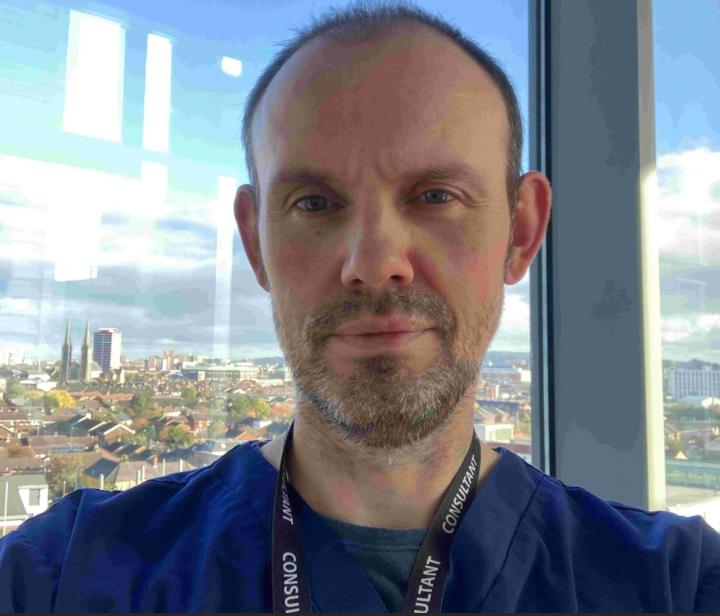
Northern Ireland has a once-in-a-generation opportunity in health data. At the heart of it is Encompass — a unified digital health record for every person in Northern Ireland, and one of the most advanced health data systems in the world. Dr Michael Quinn — consultant nephrologist, clinical informatician, and Professor of Practice at Momentum One Zero — explains what it means, and what's at stake if we don't act on it.
What does Encompass make possible that wasn't possible before?
Encompass means a person's clinical record finally follows them — GP referral, outpatient clinic, hospital admission, discharge — as a single coherent story. Most health systems don't have this. They have fragments — faxes, scanned letters, clinical memory.
What it makes possible: population-level visibility, real-time service planning, longitudinal research at scale, and the elimination of safety risks from clinicians making decisions without the full picture. It gives us a single source of truth for AI and decision support. Before Encompass, every digital health initiative in NI hit the same wall — fragmented data. That wall is gone.
How does that translate into a more efficient health system in practice?
The infrastructure does three things. It removes friction — chasing results, repeating tests, hunting for letters. It enables proactive identification of patients before they deteriorate, shifting effort from acute to planned care. And it gives us operational data to plan capacity and understand demand at a system level, rather than trust by trust.
But infrastructure alone doesn't deliver efficiency. It has to be paired with workflow redesign, capability development, and governance that lets clinicians and managers act on what the data shows. The technology is necessary — it isn't sufficient.
How real is the opportunity to turn NI's health data into an economic asset?
The opportunity is real and distinctive. 1.9 million people on a single EHR is rare anywhere in the world — a genuinely valuable asset for clinical trials, real-world evidence studies, and AI tool development.
What's needed is the trusted research environment, governance framework, and commercial model to work with the data safely and at speed. Genomics England, Finland's Findata, and Denmark's national infrastructure are useful comparators — none started with our advantage.
The risk is straightforward: if we don't move now, the window closes. Our advantage is real but it isn't permanent.
What's the most underexplored opportunity you see right now?
Two things. The nearest-term value is using Encompass data to run services better: demand forecasting, theatre utilisation, workforce planning, identifying patients drifting toward crisis. That's where data has the fastest impact on outcomes and financial sustainability.
The second is clinical AI evaluation. Tools are being deployed globally with limited real-world validation. NI's combination of a single record, an integrated commissioner-provider, and strong research base could make us where clinical AI is properly tested before it scales.
If we get this right, what does healthcare in NI look like in ten years?
A health system that learns from itself. Where every patient encounter improves the care of the next. Where clinicians spend more time with people. Where a researcher in Belfast answers questions in weeks that currently take years — and where life sciences companies build here because the data, the governance, and the clinical partnerships make it the obvious choice.
Above all, a healthier population. The point isn't digital sophistication — it's people living longer, better lives, with a system sustainable for the next generation. The infrastructure is the means; healthcare worthy of the name is the end.

Read the Summer 2026 edition free online →
Stay connected with NI's tech community: