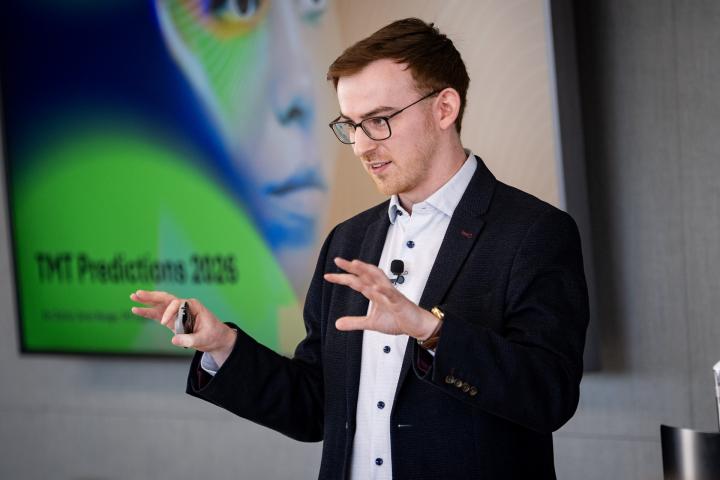
Ben Stanton, TMT Insights Senior Manager at Deloitte, sat down with us following a TMT Predictions event in Belfast to expand on some of the key forecasts in this year’s report.
Ben, one of the predictions that was of most interest to the audience was that AI tools embedded within search engines will continue to have more traffic than standalone AI tools. Why is that?
When we wrote this year’s TMT Predictions report, we considered the search engine one to be the headline prediction. I think we still do because it represents a complete upheaval of an internet economy which has been basically the same for a couple of decades.
Search is absolutely not dead; it has just changed. When these AI search results are correct, they can be extremely effective. What I also think is happening, particularly on search engines, is it’s taken a while for the average user to understand what has changed and tweak their behaviour to match it. What we're starting to see now is the rate of trigger for an AI overview to appear is going up and up. It’s not because there is a change behind the scenes or some kind of architecture change, it's because people now realize, “Oh, I can ask Google or Bing a far more complex question, and if I do so, it will generate an overview for me that wouldn't have happened before.”
So, it's taken a while for people to change their behaviour. Because it's immediate, in front of you and you use it all the time, search engines have an advantage versus standalone apps that you have to go out of your way to use. We measure it already and we're fairly confident that forecast will hold true that it'll be about three times the volume of daily use.
You said it really matters for marketing as well. How are organisations adapting?
The discipline of GEO, generative engine optimization, is quite new and a lot of the results are mixed in terms of the things you can do to create prominence for your brand in AI, whether that's in a standalone app or within a search engine. That is one approach that companies have taken. The other approach, particularly if you're a content website, is striking a partnership or deal with the platform company so that you can be prioritized as part of the architecture that surrounds the AI overview. How you surface has always been relevant and it's the flip from SEO to GEO. But the question is the same, which is how can my brand show up in a fair, representative and prominent way? There's no difference in terms of appetite from companies; it’s just the process has changed.
You made the point that for enterprises there is still a difficulty in knowing which AI projects to fund, because it is hard to directly prove the return on investment. Has that led to some organisations using the wrong metrics to judge success?
For certain job roles, it actually is easy to measure people. In sales, it's crystal clear. Your value as a salesperson is what you can execute in terms of pounds and dollars. In software engineering, depending on the kind of engineer you are, it can be relatively easy to measure you because it can be lines of code written or number of tasks executed. But across other functions, it's much harder. What I would say is it's far easier to measure processes than it is to measure people. So, when you see AI deployed for a specific process, you can measure it far more effectively – for example that process could be developing an AI tool for legal contracts. An AI tool developed for one thing that can improve one small process or part of your organization, is far easier to measure than giving an employee access to a general-purpose tool and then trying to work out how much more effective they are over the course of a quarter. The temptation is to measure something which is easy to measure.
The example I gave is measuring email outflow. Is your email outbox a good indicator of how productive you are? I'd argue no. It's maybe loosely correlated, but it's not that close. We do see more companies now starting to try and officially benchmark their people on the frequency with which they use in-house AI tools. But these are also metrics that can be gamed. You can automate prompts so that at the end of the quarter, it looks like I've been using AI a lot. It doesn’t incentivize the employee in the right way. There's a major battle for the future of culture inside organizations. Management would like that culture to be kind of AI-infused, AI-first.
Would you expect AI skills to be more in demand and required by employers across all sectors – or is that already happening?
Increasingly we see job adverts that include a requirement for a candidate for a role to be an AI advocate, to be constantly thinking about AI. I was speaking with lots of tech platforms in the last couple of weeks. Even for positions like executive assistants, where they're saying - if you want to come and work as an EA here, you need all of the aptitudes that an EA would have had in the past but they've got an extra bullet point, and that bullet point is, “I know about AI tools. I can use AI tools. I'm constantly thinking about how to make myself more efficient using them.” It is a capability companies are asking for. These are different approaches to the same problem, which is how can we encourage our people to think about using tools more, and then hopefully as an outcome, they will become more productive.
You used the phrase AI optimist and AI positive in your presentation. Do you think organisations still see AI more as an opportunity than a risk?
Largely speaking, what I see of AI tools is that they are net positive in terms of productivity or more efficient outcomes across companies. But net positive doesn't mean there is only positive. It means on balance it’s positive. And what lots of companies are missing is the whole system effect of a technology – that there is yin and yang. For every positive that technology creates, there's an inverse, and it might be outweighed by the positive but it’s still important. A really good example would be customer service.
I speak with companies all the time that are looking to transform their contact centre and customer service operations with more AI. Can we use AI to deal with customer queries faster? Will customers like our brand better if they can use AI? And while you can reduce cost by using AI as part of a customer service group, the thing that you would forget is, guess what? Your customers now have AI too, so get ready for elongated, legal-citing, Chat GPT-created complaints about you that create this extra burden. So, you've got the efficiency, but the customers have access to the same frontier tools and will critique you and grill you and threaten to take you to small claims court in far more effective ways. So, it's yin and yang. At the moment, the circles I move in are focused on what the positive is. And even though I agree it's net positive, I think don't forget about all of the ripples that are drag factors.
Are brands noticing a backlash against the use of AI? For example, it was reported in the news this week that young people are sick of having to be interviewed by AI for jobs?
The cliché that I'd quite like to shatter is that these tools will free us up to do things that are more fulfilling. There's far more nuance than that. So if you look at software engineers today, lots of people, particularly senior engineers, started writing coding in their bedroom when they were in their teens, fell in love with the art of creation through writing code, and now probably are in a career that allows them to live that dream of creation with code. Using AI tools is a very effective way to create lots of code very fast. But what it does for the engineer is it transforms their role from code creator or code writer to code review. And code review has always been a part of a software engineering role, but it's kind of the part you don't like very much. You're just kind of checking through line by line by line of code, debugging, making sure it fits with the architecture, making sure it's compliant with whatever kind of regulation you are beholden to with the kind of application you're building. I've spoken with software engineers that will say to me, “I'm so much more productive with AI tools, but I hate my job way more because I've gone from a code writer to just doing code review all the time.”
So the cliché that these tools will free us up to do things that are more fulfilling may not be the case, depending on your role, but that means that people leaders and HR leaders in particular need to be really cognizant of the transformational effects this has on the workforce because it might be you have a more productive but grumpier workforce. And if you have more churn, if you have more dissent, that's a challenge.
Is there something that's come on the horizon since you wrote the report that we should keep an eye on?
The one thing that, that will start to squeeze, a lot of the markets I work in, in the next year and beyond, probably for the next few years, is the price of memory chips. So, DRAM and NAND - acronyms that may not mean a lot to most people, but everybody, whether they use a phone, a PC, their internet router at home, their TV, their car entertainment system, will have RAM and storage with DRAM and NAND inside. It's also in drones and missiles and telecoms masts. It is every electronic product you can think of requires these memory chips - you always need processing power.
They are all in extremely short supply because the makers of these chips can only shift so many silicon wafers down a production line. The kind of chips they're building are being built for AI data centres and they will be prioritised because they're high margin. It means the amount of memory available for all other electronics is at an extreme shortage to the level that I don't think we've ever seen.
The price of memory is already up about 200% versus where it was this time last year. There will be a lag effect on electronics markets. So, you won't see it immediately but by the second half of the year, you'll see shortages of phones, shortages of PCs. The low end will disappear. The mid-range will become more expensive. There'll probably be a consolidation event where the power sits in the hands of these large buyers of memory and the smaller companies will struggle to get supply. It only gets exacerbated by energy crises and what's going on in the Middle East. It amplifies what is already going to be a really challenging year for lots of companies.
Read the Spring 2026 edition free online →
Stay connected with NI's tech community: